Same blueprint, different animals — and a family tree bush you can hold
The fastest evolution argument is a picture: one bone plan, reused everywhere. Then spin the skulls yourself in 3D and watch brain size, brow ridges, and faces change across the Homo family.
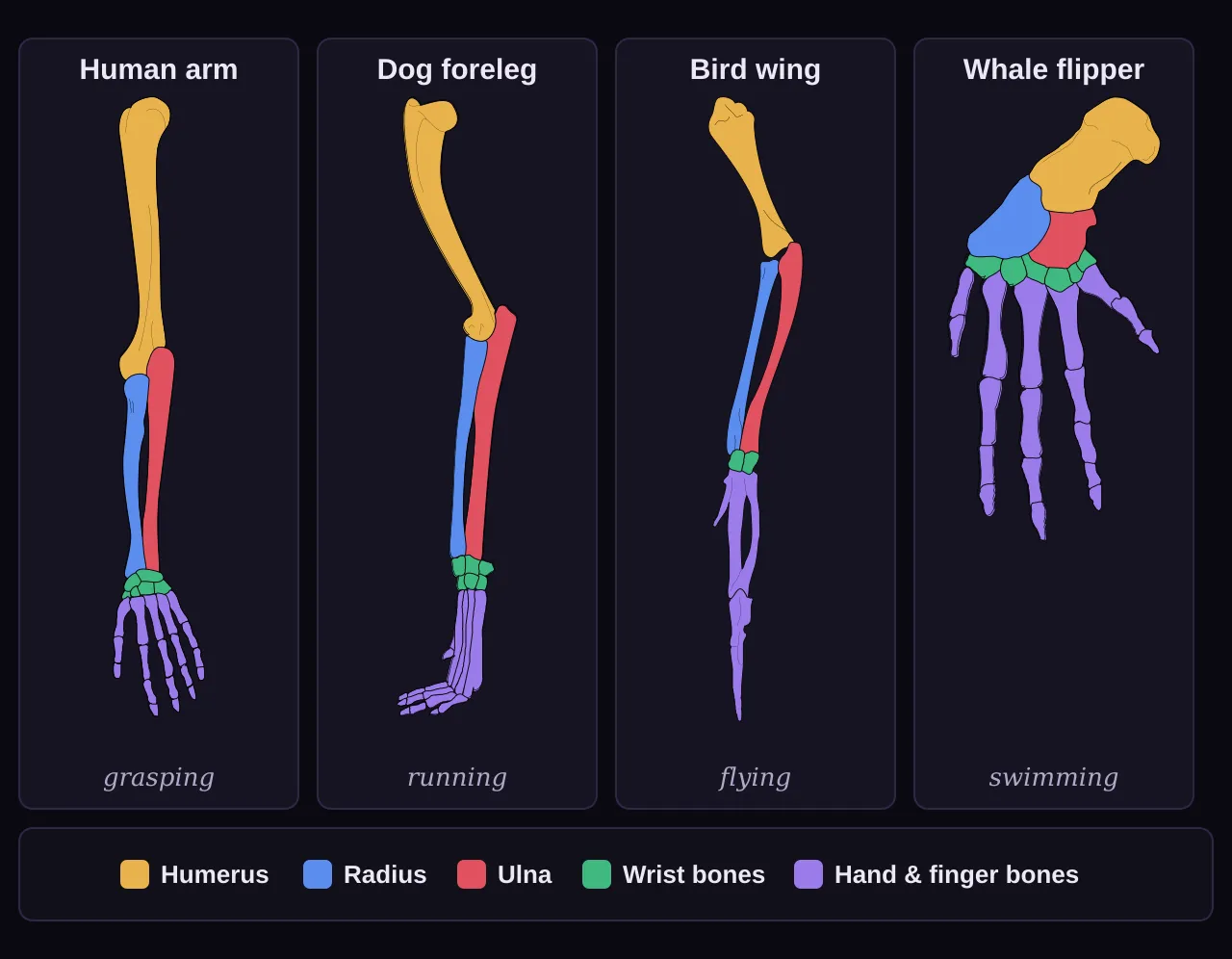
Homologous forelimbs — one plan: 1 bone, 2 bones, wrist, fingers
Whale evolution, a fossil series: Pakicetus (~50 million years ago, land mammal with a whale's inner-ear bone) → Ambulocetus (the “walking whale”) → Rodhocetus → Basilosaurus (fully aquatic, with tiny external hind legs, complete with toes; a side branch, but its relatives gave rise to modern whales) → modern whales, which still develop hind-limb buds as embryos and carry a vestigial pelvis. Very rarely, a dolphin is born with small hind fins — documented off Japan in 2006 — atavism in action.
More key facts: Humans have 23 chromosome pairs, other great apes 24 — because human chromosome 2 is two ape chromosomes fused end-to-end, with a vestigial centromere and telomeres in the middle, exactly where fusion predicts them. Endogenous retroviruses sit at the same DNA addresses in humans and chimps — shared infections, inherited. And Tiktaalik was found in 375-million-year-old rock on Ellesmere Island because scientists predicted a fish-with-a-neck should be there, then went and dug it up.
Sources: Whale evolution · Ohsumi & Kato 2008, dolphin with hind fins (Marine Mammal Science) ·IJdo et al. 1991, chromosome 2 fusion (PNAS) · Human chromosome 2 · Endogenous retroviruses · Daeschler et al. 2006, Tiktaalik (Nature)
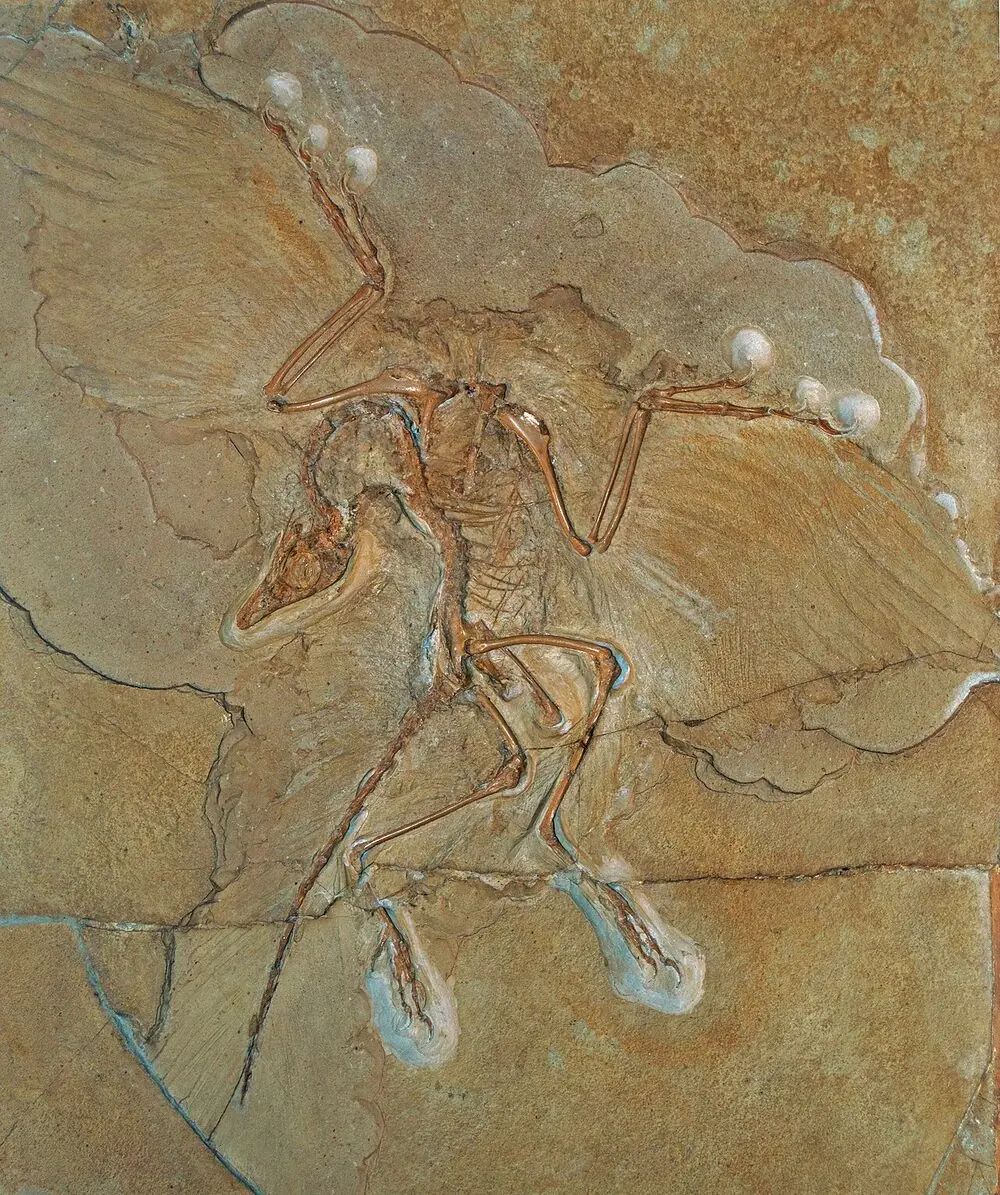
Sources: Archaeopteryx
Spin the skulls — interactive 3D
Drag to rotate, scroll to zoom. Switch species and compare: braincase size, brow ridge, face projection, chin. Models are 3D scans of fossil casts and reconstructions hosted on Sketchfab; the full Smithsonian collection is linked underneath.
Australopithecus afarensis — composite cranium (the “Lucy” species). Small braincase (~375–500 cc), projecting face, large teeth. Model: Digital Atlas of Ancient Life, via Sketchfab. Open on Sketchfab ↗
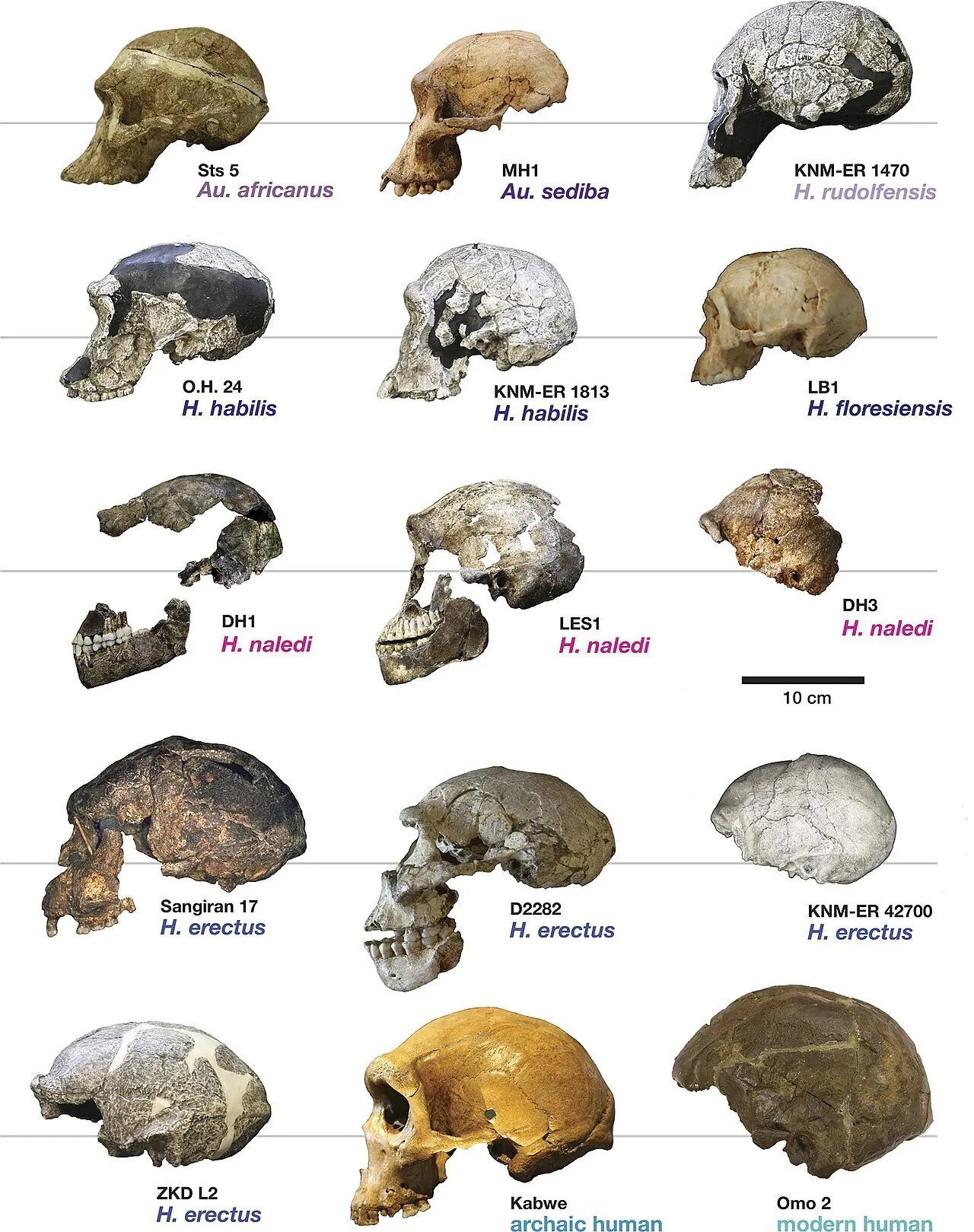
The family, side by side
| Species | Lived | Brain size | What to point at |
|---|---|---|---|
| Australopithecus afarensis (“Lucy”) | 3.9–2.9 million years ago | ~375–500 cc | Walked upright with an ape-sized brain — bipedalism came first, big brains later |
| Homo habilis | 2.4–1.6 million years ago | ~510–700 cc | Associated with early Oldowan stone tools — though older tools exist (Lomekwi, 3.3 million years ago; Oldowan, 2.6–3 million) and which species made which is unresolved |
| Homo erectus | 1.9 million – ~110,000 years ago | ~550–1,250 cc | Among the first to spread out of Africa (Dmanisi, Georgia, ~1.8 million years ago); may have used fire (evidence from ~1 million years ago, clearer after ~400,000); body proportions like ours |
| Homo heidelbergensis | ~700,000–200,000 years ago | ~1,100–1,400 cc | Possible ancestor, or close relative of the ancestors, of Neanderthals and modern humans (its species boundaries and place in the tree are debated) |
| Homo naledi | ~335,000–236,000 years ago | ~465–610 cc | Small brain, human-like hands/feet — found 2013 (announced 2015) in South Africa's Rising Star cave; whether the bodies were deliberately placed there is debated |
| Homo floresiensis (“the Hobbit”) | ~100,000–60,000 years ago | ~380–417 cc | ~1.1 m tall island species on Flores, Indonesia (stone tools until ~50,000 years ago) — likely island dwarfism, though some researchers think its ancestors were already small-bodied |
| Homo neanderthalensis | ~400,000–40,000 years ago | ~1,200–1,750 cc | Brains as large or larger than ours; made sophisticated tools and ornaments, with some evidence of deliberate burial (debated); ~1–2% of the DNA of people with non-African ancestry is Neanderthal |
| Denisovans | ~200,000–50,000 years ago (end date uncertain) | Known from DNA, proteins and a few fossils | First identified in 2010 from DNA in a finger bone; a jaw from Xiahe on the Tibetan Plateau (~160,000 years old) and, in 2025, the Harbin skull have since been linked to them (the Harbin link is debated); their DNA persists in Melanesian and Tibetan populations (altitude gene EPAS1) |
| Homo sapiens | ~300,000–315,000 years ago – now | ~1,300–1,400 cc avg | Earliest widely accepted fossils at Jebel Irhoud, Morocco (~300,000–315,000 years ago), about 100,000 years older than the previous oldest sapiens fossils; the main migration out of Africa came ~60,000–70,000 years ago |
Brain volumes are commonly published ranges for each species and vary by specimen.
Sources (Smithsonian Human Origins, then papers): A. afarensis · H. habilis · H. erectus · H. heidelbergensis · H. naledi · H. floresiensis · H. neanderthalensis · H. sapiens · Krause et al. 2010, Denisovans (Nature) · Hublin et al. 2017, Jebel Irhoud (Nature) · Reich et al. 2010, Denisovan genome (Nature) · Sutikna et al. 2016, Liang Bua dating (Nature) · Plummer et al. 2023, early Oldowan (Science) · Shen et al. 2009, Zhoukoudian dating (Nature)
Image credits — homology diagram: Vladlen666 (Волков Владислав Петрович), CC BY-SA 4.0 (recolored, relabeled and rearranged here under the same license); Archaeopteryx (Berlin specimen): Emily Willoughby, CC BY-SA 4.0; hominin skull comparison: Hawks et al. 2017, eLife, CC BY 4.0; 3D skull models via Sketchfab (Digital Atlas of Ancient Life; RLA Archaeology, UNC; Neanderthal V2) and the Smithsonian 3D Digitization program. Some images are resized or cropped.