🌲 Dendrochronology (tree rings)
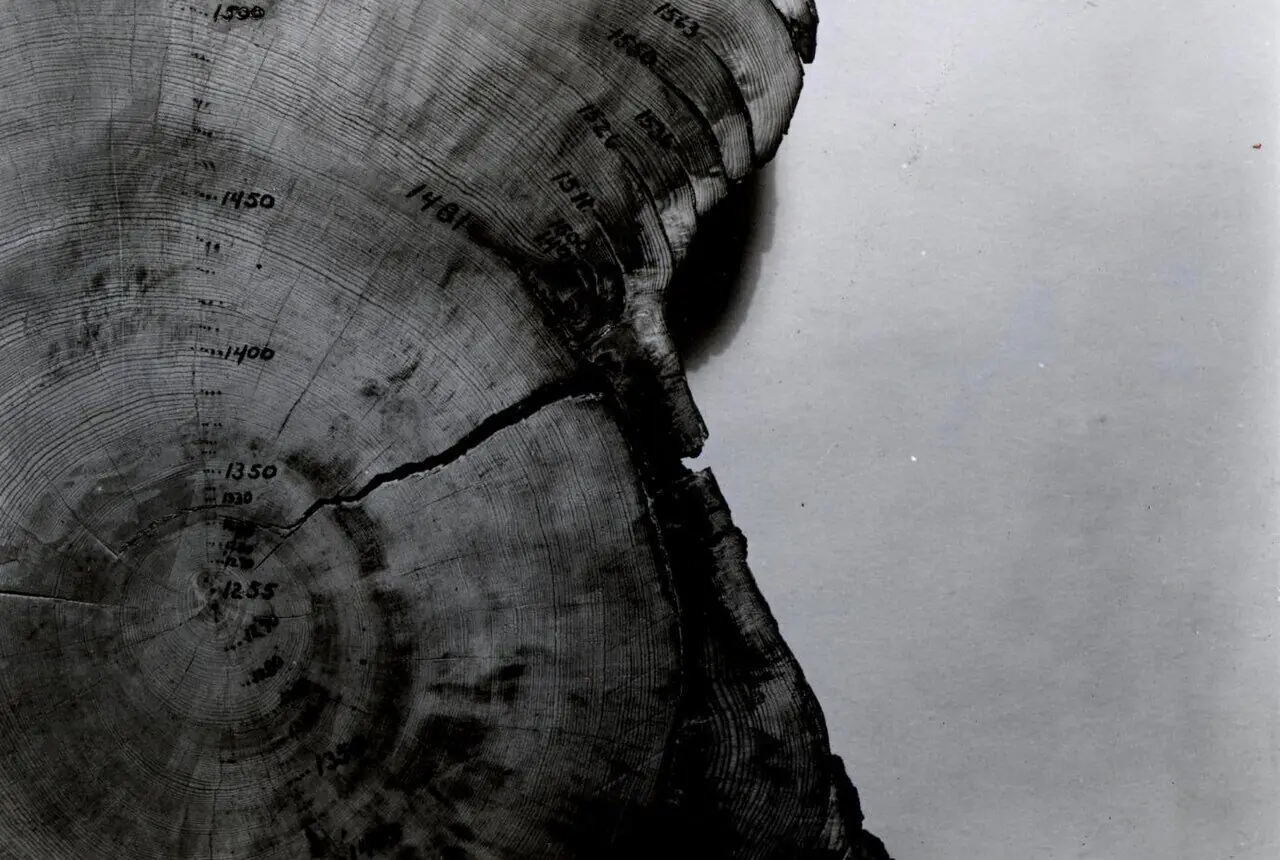
One ring per year, cross-matched between trees into continuous chronologies over 12,000 years long (German oak/pine) — absolute, to the calendar year, no radioactivity involved. It calibrates radiocarbon.
The key fact: these methods were built on different physics, different materials, and different assumptions — and where their ranges overlap, they agree. A young-Earth model has to explain why every broken clock is broken in exactly the same direction by exactly the right amount.
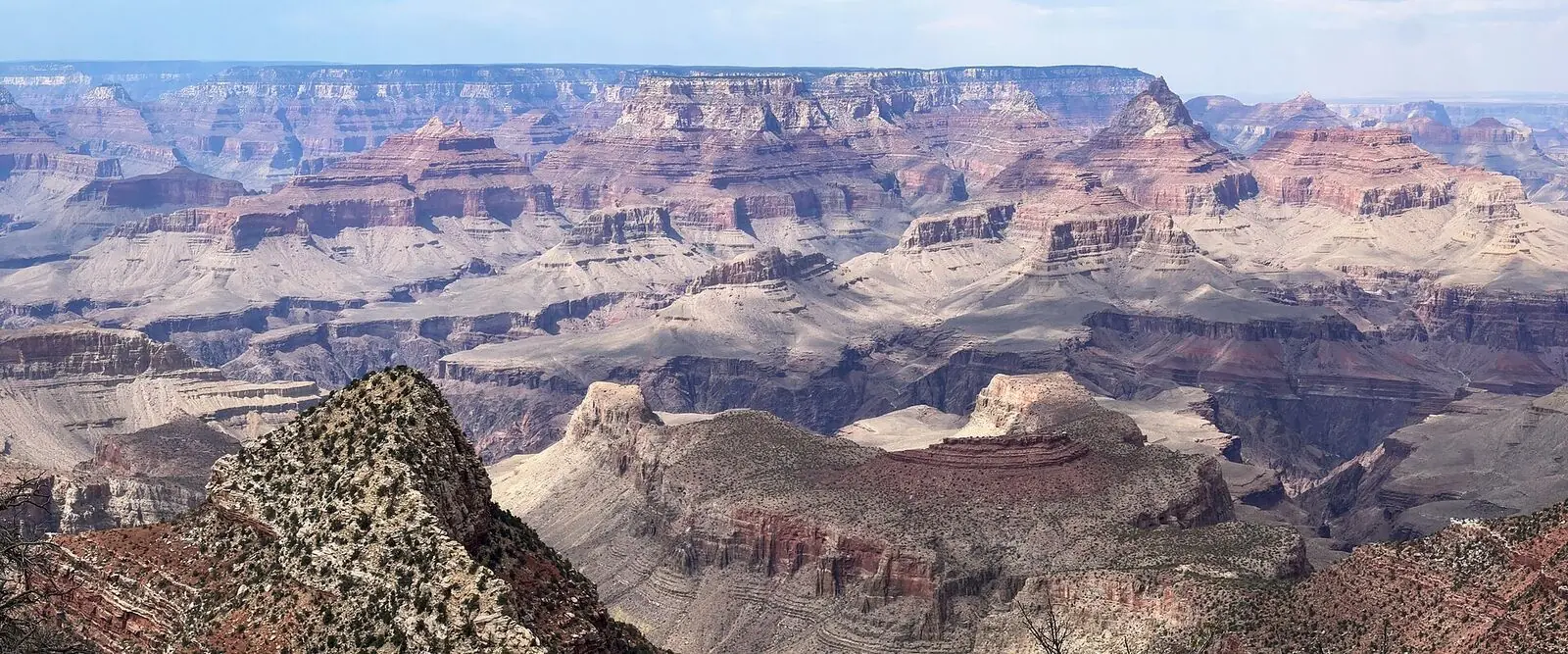
Source: NPS: Numeric ages of Grand Canyon rock layers
| Method | Parent → Daughter (half-life) | Useful range | Dates what | Key point |
|---|---|---|---|---|
| Radiocarbon (¹⁴C) | ¹⁴C → ¹⁴N (5,730 yrs) | ~300 – 55,000 yrs | Once-living material: wood, bone, charcoal, textiles | Calibrated against tree rings, U–Th-dated corals and cave deposits, and Lake Suigetsu varves — it's checked, not assumed |
| Uranium–Lead (U–Pb) | ²³⁸U → ²⁰⁶Pb (4.47 billion yrs); ²³⁵U → ²⁰⁷Pb (704 million yrs) | ~1 million – 4.5+ billion yrs | Zircon crystals in igneous rock; meteorites | Two decay chains in one crystal cross-check each other (concordia). Lead-isotope ratios in meteorites date the Solar System, and Earth with it |
| Potassium–Argon (K–Ar) | ⁴⁰K → ⁴⁰Ar (1.25 billion yrs) | ~100,000 yrs – billions | Volcanic rock & ash layers | The workhorse for hominin sites — dates the ash above/below fossils |
| Argon–Argon (⁴⁰Ar/³⁹Ar) | Same clock as K–Ar, measured by neutron irradiation | ~2,000 yrs – billions | Single volcanic crystals | More precise successor to K–Ar; dated the Pompeii ash and Olduvai Gorge layers |
| Rubidium–Strontium (Rb–Sr) | ⁸⁷Rb → ⁸⁷Sr (48.8 billion yrs) | ~10 million yrs – billions | Whole rocks, meteorites | Isochron method solves for the starting daughter amount, provided the samples formed together and stayed closed |
| Samarium–Neodymium (Sm–Nd) | ¹⁴⁷Sm → ¹⁴³Nd (106 billion yrs) | Tens of millions of yrs – billions | Basalt, garnet, meteorites | Relatively resistant to resetting — used on the oldest rocks and lunar samples |
| Lutetium–Hafnium (Lu–Hf) | ¹⁷⁶Lu → ¹⁷⁶Hf (37 billion yrs) | Tens of millions of yrs – billions | Garnet, apatite, meteorites | Garnet Lu–Hf dates metamorphism; in zircon, Hf isotopes read alongside U–Pb trace the magma's source |
| Rhenium–Osmium (Re–Os) | ¹⁸⁷Re → ¹⁸⁷Os (41.6 billion yrs) | Tens of millions of yrs – billions | Sulfide ores, black shales, meteorites | Dates the deposition of organic-rich shales directly — rocks with no volcanic minerals for K–Ar or U–Pb |
| Uranium–Thorium (U–Th) | ²³⁰Th disequilibrium (75,600 yrs) | ~100 – 500,000 yrs | Corals, cave formations (speleothems), bone | Gave minimum ages for cave paintings by dating the carbonate crust over them; dates ancient sea levels; cross-checks ¹⁴C |
| Fission-track | ²³⁸U spontaneous fission scars | ~100,000 yrs – billions | Zircon, apatite, volcanic glass | Physically count the damage tracks — a clock you can see under a microscope |
| Cosmogenic nuclide | ¹⁰Be (1.39 million yrs), ²⁶Al (717,000 yrs), ³⁶Cl | ~1,000 – ~10 million yrs | Exposed rock surfaces, buried sediment | Measures how long a surface has sat under cosmic rays — dates glacial moraines & burial of cave fossils |
| Luminescence (OSL / TL) | Trapped-charge accumulation (not decay) | ~100 – 300,000+ yrs | Buried sand grains, fired pottery & hearths | Dates the last time grains saw sunlight — fills the gap beyond radiocarbon |
| Electron spin resonance (ESR) | Trapped-charge accumulation | ~10,000 – ~2 million yrs | Tooth enamel, shells, quartz | Dates teeth directly at sites where nothing volcanic exists |
| Amino-acid racemization | L- → D-amino acid conversion (temperature-dependent) | Relative / calibrated, up to ~1 million yrs | Shells, bone, eggshell | A relative clock — powerful for ranking & cross-checking within a region |
Sources: USGS: Radiometric time scale · USGS: Age of the Earth · IntCal20 radiocarbon calibration (Radiocarbon) · Bronk Ramsey et al. 2012, Lake Suigetsu (Science) · Luminescence dating · Fission-track dating
One ring per year, cross-matched between trees into continuous chronologies over 12,000 years long (German oak/pine) — absolute, to the calendar year, no radioactivity involved. It calibrates radiocarbon.
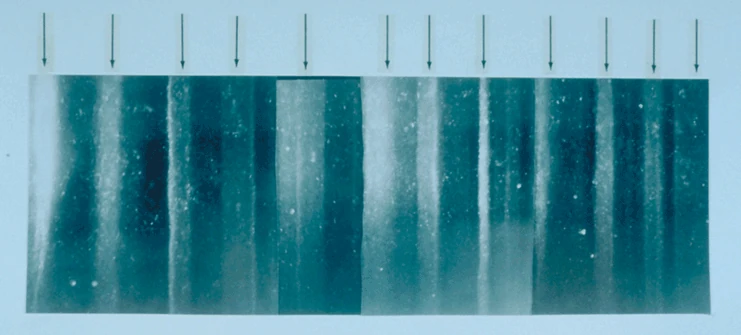
Annual snowfall layers counted directly in Greenland cores to ~60,000 years (GICC05). Antarctic snowfall is too thin to count year by year, so the EPICA Dome C core's ~800,000 years comes from an ice-flow model checked against dated markers. Volcanic sulfate spikes (and sometimes microscopic ash) line up with recorded eruptions such as Laki 1783 and Tambora 1815 — an internal check.
Paired sediment layers, one per year. Japan's Lake Suigetsu has ~50,000 years of countable varves (some gapes interpolated) with leaves embedded in them — the leaves get radiocarbon-dated, directly calibrating ¹⁴C against a counted calendar.
Earth's magnetic field has flipped hundreds of times, leaving a barcode in rocks and seafloor worldwide. The reversal sequence is calibrated against radiometric dates and astronomical cycles, then readable everywhere — including at hominin sites.
Most volcanic eruptions leave a distinctive chemical fingerprint. An ash layer dated once by Ar–Ar can be identified — and its date applied — hundreds of miles away.
Index fossils: species that lived briefly and spread widely order rock layers globally. This relative sequence was worked out in the 1800s — before radioactivity was discovered — and radiometric dates later matched it.
In undisturbed sequences, deeper = older. Simple, observable, and the framework every other method slots into.
Archaeomagnetism (fired clay records the local magnetic field, matched to dated curves), obsidian hydration, lichenometry (lichen growth on exposed rock, a coarser method), and thermoluminescence of burnt flint round out the kit for archaeology.
Sources: Dendrochronology · Svensson et al. 2008, GICC05 Greenland chronology (Climate of the Past) · Parrenin et al. 2007, EDC3 Antarctic chronology (Climate of the Past) · Varves · Magnetostratigraphy · Tephrochronology · Index fossils
The consilience close: Young-Earth models don't just need one clock to fail. They need tree rings, ice layers, lake varves, magnetic reversals, and seven different radioactive parent isotopes (from uranium, potassium, rubidium, samarium, lutetium and rhenium) all wrong, all by the same factor, and all agreeing with each other by coincidence. Each additional independent agreement makes coincidence less likely.
On “were you there?”: decay rates are tested in labs, in the Oklo natural nuclear reactor (Gabon, ~2 billion years ago — it could only run because ²³⁵U was then ~3% of natural uranium, as today's half-lives predict, and its fission-product ratios show nuclear physics then matched today's), and in supernova 1987A, whose light traveled ~165,000 years to reach us while its light curve followed the cobalt-56 half-life (~77 days) to within a few percent for the first year or so.
Sources: Oklo natural reactor · Uzan, The fundamental constants and their variation, incl. Oklo (arXiv) · SN 1987A · The light curve of SN 1987A revisited (arXiv)
Image credits — Grand Canyon from Grandview Point: National Park Service, public domain; ice core: NOAA / NCDC Paleoclimatology, US government, public domain; tree rings: USDA Forest Service, 1937, US government, public domain. Some images are resized or cropped.