A community reference for atheists & anyone deconstructing their faith
Big Bang
13.8 billion years, written in light
The Big Bang isn't a belief — it's the surviving explanation for several largely independent lines of evidence: galaxies receding, a predicted all-sky afterglow that was then found, the universe's chemical recipe, and telescopes literally seeing younger galaxies when they look farther away.
The smoking gun: the Cosmic Microwave Background
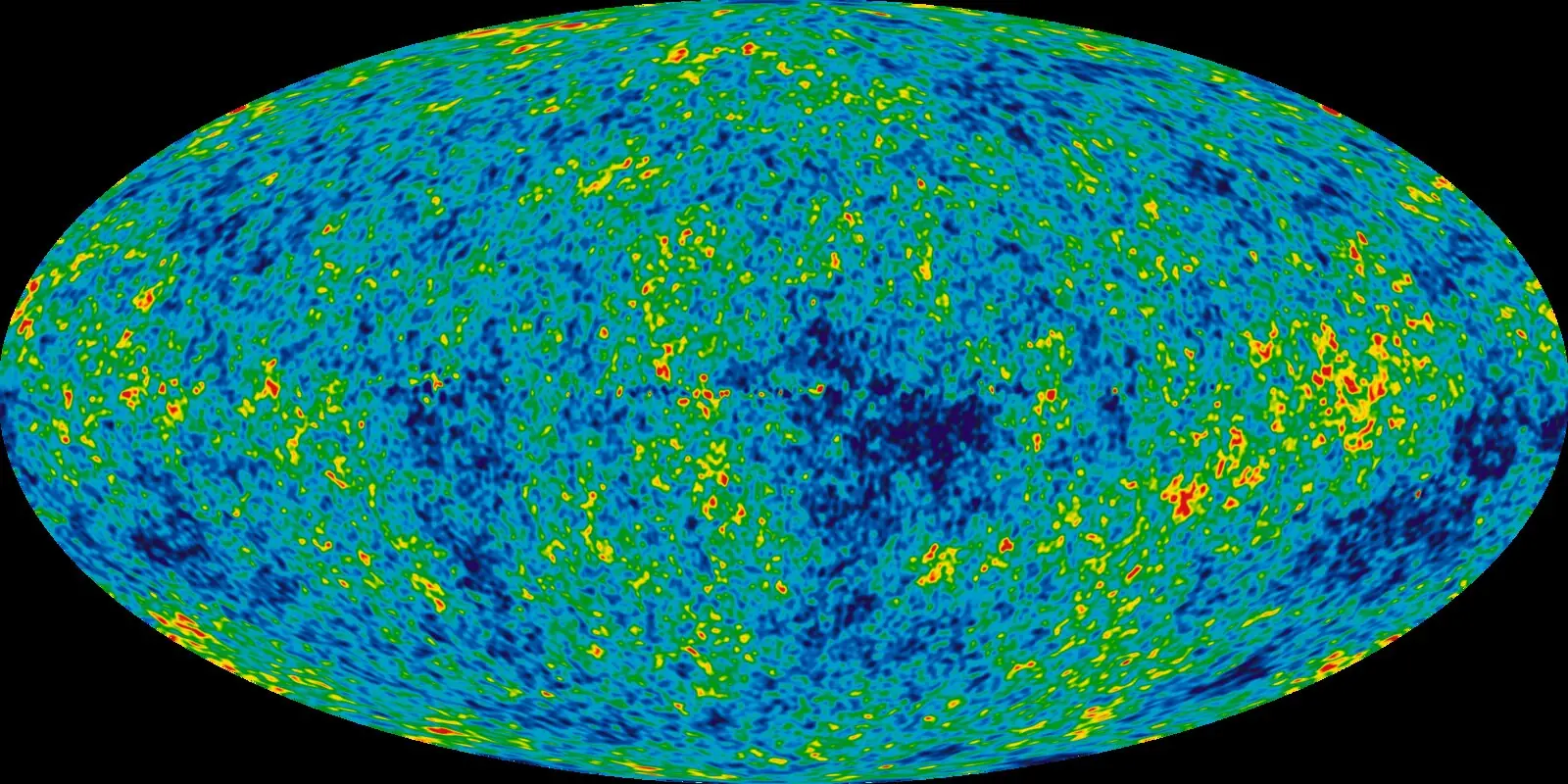
The CMB as mapped by NASA's WMAP (nine-year map). Light released ~380,000 years after the Big Bang, when the universe first became transparent — stretched by expansion from visible light into microwaves, now at 2.725 K. The mottling is real structure: temperature differences of about one part in 100,000, the seeds that gravity grew into galaxies. ESA's Planck satellite later mapped it in even finer detail (2018 final release). A static, eternal universe has no business having this afterglow; the Big Bang predicted it (Gamow, Alpher & Herman, 1948) before Penzias & Wilson stumbled on it in 1965 and won the Nobel Prize.
The missions — what each satellite actually discovered
Mission
Flew
What it found / proved
COBE (NASA)
1989–1993
FIRAS showed the CMB is a near-perfect blackbody at 2.725 K — matching a hot early universe, not starlight. DMR found the first temperature ripples (anisotropies). Nobel Prize 2006 (Mather & Smoot)
WMAP (NASA)
2001–2010
Sharpened the CMB ~30× over COBE: universe is 13.77 billion years old, geometrically flat, and only ~4.6% ordinary matter — the rest is dark matter (~24%) and dark energy (~71%)
Planck (ESA)
2009–2013
The definitive CMB map (above): age 13.787 ± 0.020 billion years (2018 results with BAO data), composition 4.9% ordinary matter / 26.2% dark matter / 68.9% dark energy, and ripple statistics (nearly scale-invariant, Gaussian, flat) that agree with what simple inflation models predict while ruling out many alternatives
Hubble Space Telescope
1990–
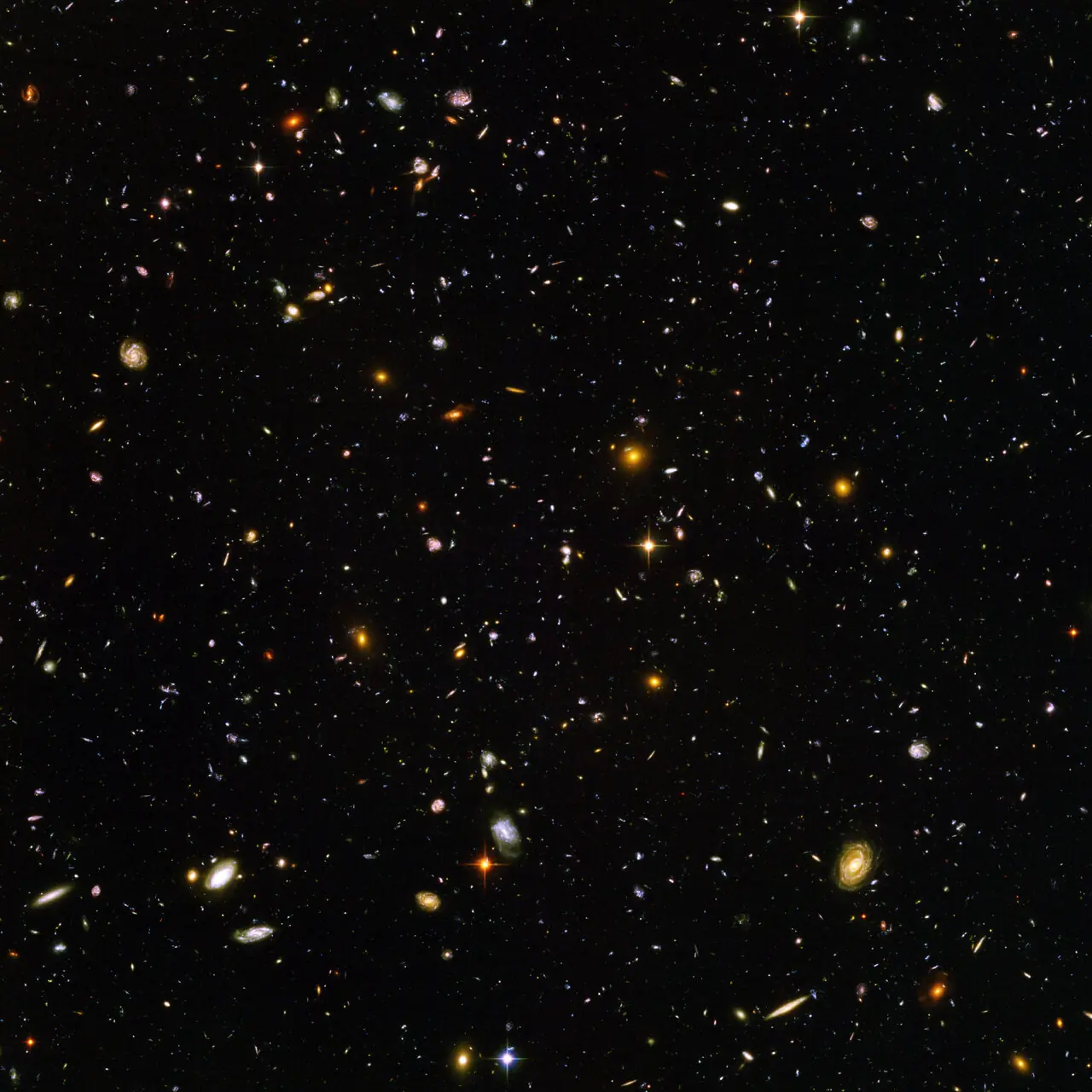
Measured the expansion rate (the Hubble constant) with distance ladders — ~73 km/s/Mpc, cross-checked by JWST, a bit higher than the CMB-based ~67 (the unresolved “Hubble tension”; either way the age comes out at roughly 13–14 billion years) — and took the Deep Fields: thousands of galaxies (~3,000 in 1995, ~10,000 in the Ultra Deep Field) in a “blank” patch of sky no bigger than a pinhead held at arm's length
James Webb (JWST)
2021–
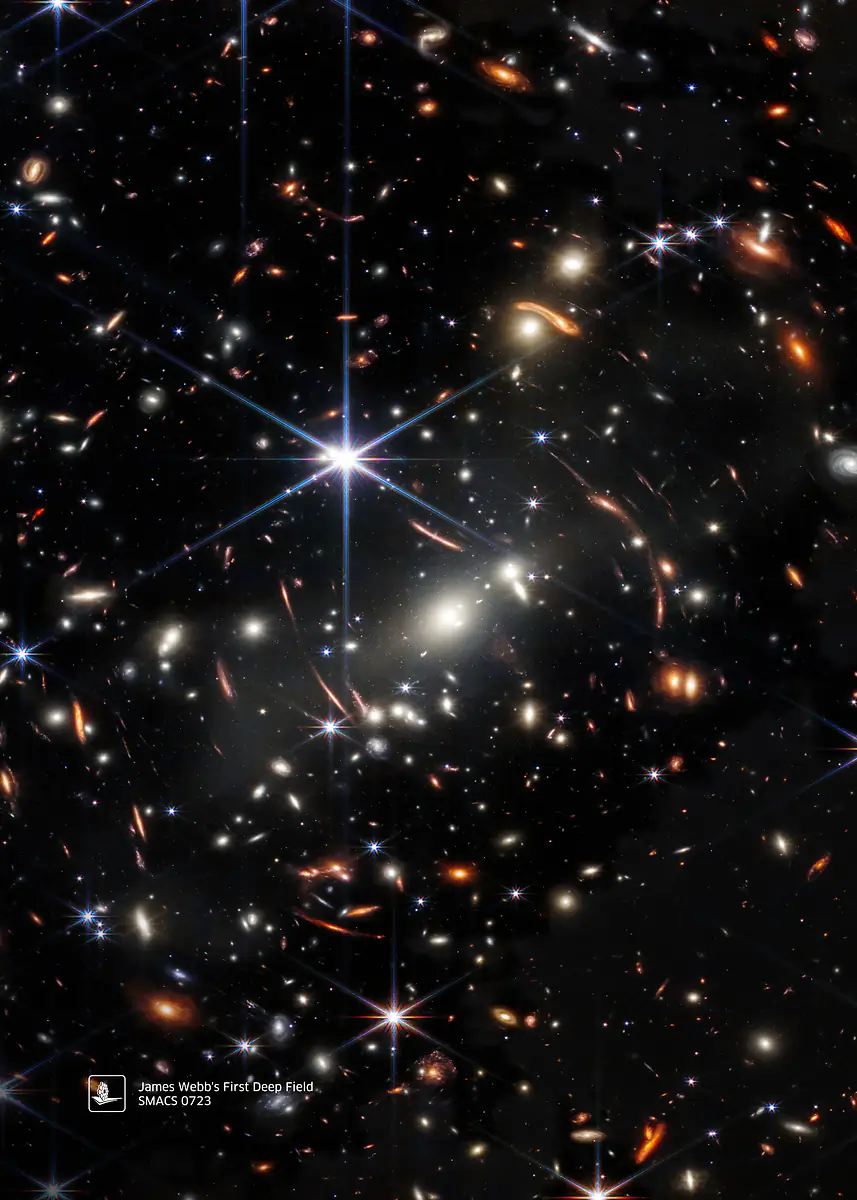
Infrared eyes that see the most distant galaxies confirmed so far — as they were ~280–300 million years after the Big Bang (record: MoM-z14, redshift 14.4); its 2022 First Deep Field shows gravitationally lensed galaxies magnified by cluster SMACS 0723
Euclid (ESA)
2023–
Mapping billions of galaxies to chart dark matter and measure how dark energy has driven expansion across ~10 billion years
Gaia (ESA)
2013–2025
Measured positions & motions for well over a billion stars — the Milky Way's own archaeology, including evidence of an ancient galaxy collision (Gaia-Enceladus-Sausage, ~10 billion years ago)
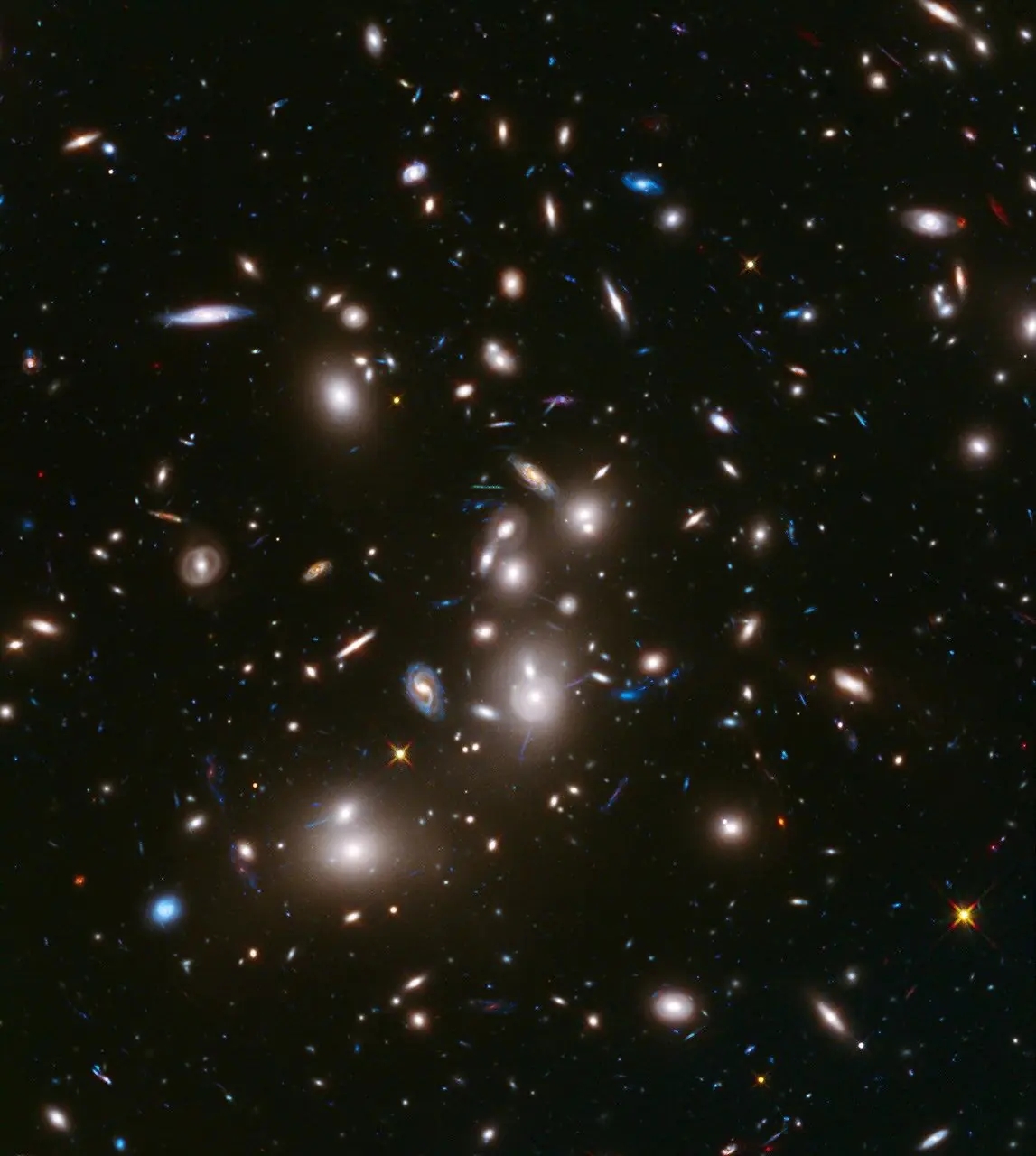
Hubble Ultra Deep Field. Point the telescope at “nothing” for days and the nothing contains ~10,000 galaxies in that one pinprick. Looking far away = looking back in time: these galaxies are seen as they were billions of years ago, and the farther ones are systematically younger, smaller and more irregular — evolution of galaxies, observed directly.Abell 2744 — Pandora's Cluster (Hubble Frontier Fields). The cluster's gravity acts as a natural telescope (gravitational lensing — a direct prediction of general relativity), magnifying galaxies behind it from the universe's first billion years.
JWST's First Deep Field — SMACS 0723 (July 2022). Thousands of galaxies in a patch of sky covered by a grain of sand held at arm's length; the warped arcs are galaxies far behind the cluster, lensed by its gravity, some seen as they were >13 billion years ago. Webb found mature galaxies earlier than many models expected — note the honest framing: that revises galaxy-formation timelines, it does not rescue a young universe; the redshifts and light-travel times are the observation.
Four lines of evidence — in brief
1 · Expansion
Galaxies' light is redshifted in proportion to distance (Hubble–Lemaître law). Run the film backwards and everything converges ~13.8 billion years ago. This was Lemaître — a Catholic priest and physicist — in 1927, before it was anyone's “atheist doctrine.”
2 · The CMB
Predicted, then found, then mapped by three generations of satellites (COBE → WMAP → Planck) with ever-sharper agreement. Its blackbody perfection is inexplicable in a young or static cosmos.
3 · The chemical recipe
Big Bang nucleosynthesis predicts ~75% hydrogen / ~25% helium-4 (by mass) plus traces of deuterium, helium-3 and lithium-7. Helium-4 and deuterium, measured in the most pristine gas, match closely — stars destroy deuterium, and no known process can supply the observed amount — and the deuterium-based baryon density agrees with the CMB. One known mismatch: predicted lithium-7 is about 3× what old stars show (the “lithium problem”), still an open question that doesn't change the overall picture.
4 · Lookback time
Distant = younger, observed directly in deep fields. Supernova 1987A's glowing ring gives a purely geometric distance of ~165,000 light-years, and its light curve followed the lab-measured cobalt-56 decay — that light traveled ~165,000 years, so the universe is demonstrably far older than 6,000 years in every direction we look.
Honest-science note: the Big Bang model describes the universe expanding from a hot, dense early state; it does not by itself claim to explain what, if anything, preceded that state. Saying “science doesn't know everything” is true and irrelevant — the expansion and afterglow are measured, and the age follows from them (agreeing with the oldest stars). Open questions remain — the exact expansion rate, what dark matter and dark energy are, what came before — but none concern whether the universe is billions of years old, and a 6,000-year cosmos can't accommodate the data.
Image credits — CMB map: NASA / WMAP Science Team, public domain; Hubble Ultra Deep Field: NASA, ESA, S. Beckwith (STScI) and the HUDF Team, public domain (edited version via Wikimedia Commons); Abell 2744: NASA, ESA, J. Lotz, M. Mountain, A. Koekemoer and the HFF Team (STScI); JWST First Deep Field: NASA/ESA/CSA/STScI. Some images are resized or cropped.